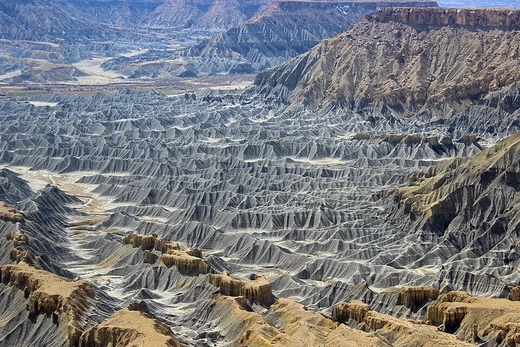
Escarpment
A steep slope or long cliff separating two level areas.

An escarpment is a steep slope or long cliff that forms as a result of faulting or erosion and separates two relatively level areas having different elevations. The term is sometimes incorrectly used interchangeably with scarp, which refers to a cliff or a steep slope; in precise usage, an escarpment is a ridge that has a gentle slope on one side and a steep scarp on the other side. More loosely, scarp also describes a zone between a coastal lowland and a continental plateau that shows a marked, abrupt change in elevation caused by coastal erosion at the base of the plateau.
- fault_scarp_origin
- Created when a dip-slip fault displaces the ground surface so that one side is higher than the other; strike-slip faults can also produce scarps, such as pressure ridges or linear scarps along fault t
Lore & Background
Scarps are generally formed by one of two processes: by differential erosion of sedimentary rocks or by movement of the Earth's crust at a geologic fault. The former is the more common type: the escarpment is a transition from one series of sedimentary rocks to another series of a different age and composition. Escarpments are also frequently formed by faults. When a fault displaces the ground surface so that one side is higher than the other, a fault scarp is created. That can occur in dip-slip faults, and also in strike-slip faults, which can produce scarps such as pressure ridges or linear scarps along fault traces.
Reader's Guide
Escarpments are significant as major landforms that mark boundaries between regions of different elevation, often influencing drainage patterns, human settlement, and transportation routes. Their formation through faulting or differential erosion provides key evidence of geological processes such as crustal movement and sedimentary layering. The distinction between escarpment and scarp, though often blurred in casual use, is important in geology: an escarpment is the entire ridge with a gentle slope on one side and a steep scarp on the other, while a scarp is specifically the steep face. The presence of escarpments on other planets, where they are called rupes, indicates that similar cooling and contraction processes occur throughout the Solar System. Over geological time, escarpments erode gradually, and the varying rock types within them weather at different speeds, revealing stages of deformation in exposed layers.
Did You Know?
- The term scarp is often incorrectly used interchangeably with escarpment, but escarpment refers to the margin between two landforms, while scarp refers to a cliff or steep slope.
- Escarpments are believed to occur on other planets when the crust contracts as a result of cooling.
- On Mercury, Mars, and the Moon, the Latin term rupes is used for an escarpment.
- Escarpments erode gradually and over geological time, with different rock types weathering at different speeds based on a combination of physical and chemical processes.
Frequently Asked Questions
What is an escarpment in geomorphology?
An escarpment is a long, steep slope or cliff that divides two relatively flat areas sitting at different elevations. In precise usage it describes a ridge with a gentle slope on one face and an abrupt drop on the other.
How does an escarpment differ from a scarp?
A scarp is simply any cliff or steep slope, whereas an escarpment specifically denotes a ridge combining a gentle slope on one side with a steep scarp face on the other. The terms are often swapped in casual speech, but they carry distinct technical meanings in geomorphology.
What geological processes create escarpments?
Differential erosion and fault-related ground displacement are the two main mechanisms. A dip-slip fault can raise one crustal block above another to form a linear step, while coastal erosion undercutting a plateau base can carve out a marked elevation break.
Can strike-slip faults produce escarpment-like features?
Yes, strike-slip faulting can generate linear scarps and pressure ridges that function as escarpment-like steps. These tend to be narrower and more localized than the broad ridges typically produced by dip-slip mechanisms.
Why are escarpments important in coastal and fluvial settings?
They mark the boundary between a coastal lowland and an adjacent continental plateau, recording where erosion has carved into the base of higher ground. This boundary strongly influences drainage patterns, sediment transport, and the long-term evolution of both river systems and coastlines.
More in Coastal And Fluvial Geomorphology 25-32
Elsewhere in the Coastal And Fluvial Geomorphology universe
Spotted an error? Know more?
This is a living reference — every entry is fact-audited, and reader corrections feed straight into our audit queue. Suggest an edit · See this site's audit record