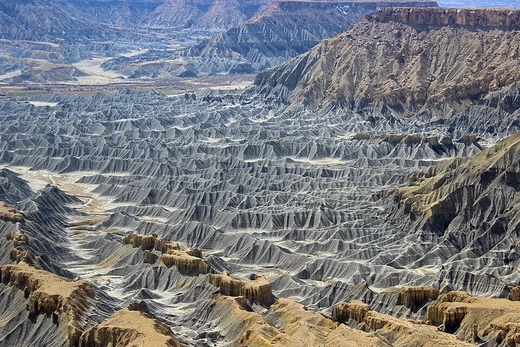
Dry lake
A dry lake bed forms when evaporation exceeds water inflow.

A dry lake bed, also called a playa, is a basin or depression that formerly contained a standing surface water body, which disappears when evaporation processes exceed recharge. If the floor of a dry lake is covered by deposits of alkaline compounds, it is called an alkali flat; if covered with salt, it is called a salt flat. Dry lakes are typically formed in semi-arid to arid regions and are known by various regional names, including salar in South America, pan in South Africa, sabkha in Arabic, and takyr in Central Asia.
- formation
- Water inflow into a dry depression, with evaporation exceeding inflow
- regional terms
- playa, salar, pan, sabkha, takyr, kavir
- notable phenomenon
- Sailing stones at Racetrack Playa, Death Valley, California
- human uses
- Land speed records, air bases, mineral extraction, Burning Man event
Lore & Background
Dry lakes are formed when rain or groundwater flows into a depression, creating a temporary pond or lake. If total annual evaporation exceeds total annual inflow, the water disappears, leaving behind precipitated salts that build up over time. The resulting surface is a flat bed of clay, often encrusted with evaporite minerals such as sodium carbonate and borax. In deserts, dry lakes may be ringed by bajadas. Many dry lakes contain shallow water during the rainy season. If the water layer is thin and moved by wind, an exceedingly hard and smooth surface develops. Thicker water layers produce cracked-mud surfaces and teepee structure desiccation features. The Racetrack Playa in Death Valley features sailing stones, which move across the surface due to a precise combination of water depth, ice formation, and wind. Dry lake beds are typically devoid of vegetation but are ringed by salt-tolerant plants like shadscale and saltbrush. Threats include pollution from cattle feedlots, agricultural runoff, overgrazing, and the invasive shrub Kochia prostrata.
Reader's Guide
Dry lake beds are significant as unique geological and ecological features in arid regions worldwide. They preserve evidence of past water bodies and serve as important habitats for rare species adapted to extreme conditions. Their flat, hard surfaces have made them valuable for human activities, including land speed record attempts at Bonneville Salt Flats and Black Rock Desert, air bases such as Edwards Air Force Base and Groom Lake, and mineral extraction from subsurface brines. The Burning Man event is held annually on a playa in the Black Rock Desert. Under United States law, playa lakes may be considered isolated wetlands eligible for conservation programs.
Did You Know?
- The Racetrack Playa in Death Valley features sailing stones that move due to ice panels blown by wind.
- The term 'playa' is Spanish for 'beach' and is used in parts of Mexico and the western United States.
Frequently Asked Questions
What exactly is a dry lake?
A dry lake (commonly called a playa) is a low-lying basin that once held a standing body of surface water but has since dried out because evaporation outpaced any new water inflow. They are most common in semi-arid to arid climates.
What are the different regional names for a dry lake?
Depending on location, the same feature goes by several names: salar in South America, pan in South Africa, sabkha in Arabic-speaking regions, takyr in Central Asia, and kavir in Persian contexts. In the United States the term 'playa' is the most widely used.
What is the most famous dry-lake phenomenon?
The 'sailing stones' of Racetrack Playa in Death Valley, California, where boulders mysteriously slide across the dried lakebed leaving long trails behind. The flat surface has also hosted land-speed-record attempts, served as an air base, and been the site of the annual Burning Man gathering.
More in Coastal And Fluvial Geomorphology 25-32
Elsewhere in the Coastal And Fluvial Geomorphology universe
Spotted an error? Know more?
This is a living reference — every entry is fact-audited, and reader corrections feed straight into our audit queue. Suggest an edit · See this site's audit record