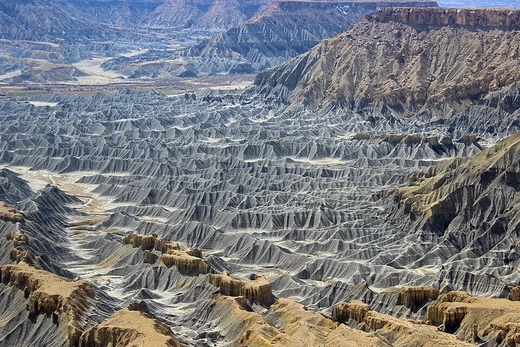
Distributary
A stream channel that branches away from a main river.

A distributary, or distributary channel, is a stream channel that branches off and flows away from a main stream channel, opposite to a tributary. Distributaries result from river bifurcation and are commonly found where a river approaches a lake or ocean, forming networks in river deltas, though they can also occur inland on alluvial fans or near confluences. In some cases, a minor distributary may divert so much water that it becomes the main route.
- type
- geographic feature
- field
- hydrology, fluvial geomorphology
- known_for
- branching off from a main river channel, forming deltas and alluvial fans
- related_terms
- arm, channel, anabranch (Australia), braided river (North America)
Lore & Background
Distributaries are the opposite of tributaries, forming when a river bifurcates. They are common in river deltas, such as the Mississippi River's Atchafalaya distributary in Louisiana, which has captured increasing flow due to a steeper route to the Gulf of Mexico. Inland distributaries occur on alluvial fans, as seen with the Kings River in California, which splits into distributaries flowing north to the San Joaquin River and south to an endorheic basin. The Casiquiare canal in South America is a unique inland distributary linking the Orinoco and Amazon river systems. In Europe, the Rhine splits into the IJssel, Waal, and Nederrijn, while the Danube has the Little Danube distributary in Slovakia. In Asia, the Huai River in China splits into three streams, and the Ganges has distributaries like the Padma and Hoogli. The Nile historically had seven distributaries, though only the Rosetta and Damietta remain. In Australia, distributaries like Yarriambiack Creek flow intermittently into shallow lakes, and in New Zealand, the Clutha River splits into the Matau and Koua arms.
Reader's Guide
Distributaries are significant in shaping landscapes and human geography. They create fertile deltas, such as the Nile Delta, and influence navigation and flood risk. The Atchafalaya River's capture of Mississippi flow highlights the dynamic nature of distributaries, requiring engineering controls like the Old River Control Structure to maintain shipping routes. Inland distributaries on alluvial fans, like those of the Kings River, affect water distribution in arid regions. The Casiquiare canal demonstrates how distributaries can connect major river systems, while the Okavango Delta shows distributaries that end in inland basins without reaching the sea. Understanding distributaries is crucial for managing water resources, floodplains, and ecosystems, as seen in the flood-prone alluvial fans of Himalayan rivers. Their study informs delta architecture and sediment deposition, as noted in research by Olariu and Bhattacharya.
Did You Know?
- The Atchafalaya River is a distributary of the Mississippi that has captured increasing flow due to a steeper route to the Gulf of Mexico.
- The Casiquiare canal is the largest river on the planet that links two major river systems, the Orinoco and Amazon.
- The Nile historically had seven distributaries, according to Pliny the Elder, but now only the Rosetta and Damietta branches remain.
- In Australia, a distributary that diverts from the main course and rejoins it later is called an anabranch.
More in Coastal And Fluvial Geomorphology 1-24
Elsewhere in the Coastal And Fluvial Geomorphology universe
Spotted an error? Know more?
This is a living reference — every entry is fact-audited, and reader corrections feed straight into our audit queue. Suggest an edit · See this site's audit record