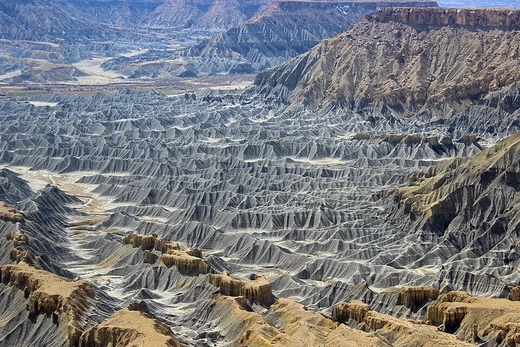
Bedform
Geological features formed at fluid-moveable bed interfaces.

A bedform is a geological feature that develops at the interface of fluid and a moveable bed, resulting from bed material being moved by fluid flow. Examples include ripples and dunes on the bed of a river. Bedforms are often preserved in the rock record as a result of being present in a depositional setting, and they are often characteristic to the flow parameters, which may be used to infer flow depth and velocity, and therefore the Froude number.
- field
- Geology, sedimentology
- known_for
- Geological features formed by fluid flow on a moveable bed
- types
- Ripples, dunes, lower plane bed, upper plane bed
- initiation_models
- Defect initiation, instantaneous initiation
Lore & Background
Bedforms are omnipresent in many environments, including fluvial, eolian, glaciofluvial, deltaic and deep sea, although there is still debate on how they develop. Two separate, though not mutually exclusive, models of bedform initiation exist: defect initiation and instantaneous initiation. The defect theory proposes that turbulent sweeps entrain sediment that upon deposition generates defects in a non-cohesive material, which then propagate downstream via flow separation. The origin of these defects is thought to be linked to packets of hairpin vortex structures, which give rise to entrainment corridors and grain lineations that interact with low-speed streaks, forming an agglomeration of grains. Once a critical height is reached, flow separation occurs, and sediment is eroded near the reattachment point and deposited downstream, creating a new defect that propagates the process.
Reader's Guide
Bedforms are significant because they are preserved in the rock record and can be used to infer past flow conditions, such as depth, velocity, and the Froude number, aiding in the reconstruction of paleoenvironments. Phase or stability diagrams are used for prediction of bed states in known flow and sediment transport conditions and as a tool for paleoenvironmental reconstruction, though they are difficult to construct due to the number of variables needed. The study of bedforms also highlights ongoing scientific debates, such as whether bedforms can occur under laminar flows, which would suggest alternative processes for defect development beyond those proposed for turbulent flows. This uncertainty underscores the complexity of bedform dynamics and the need for further research.
Did You Know?
- Bedforms are often preserved in the rock record as a result of being present in a depositional setting.
- There are two separate, though not mutually exclusive, models of bedform initiation: defect initiation and instantaneous initiation.
- The defect theory proposes that defects originate from packets of hairpin vortex structures in turbulent flows.
- Instantaneous initiation may be a manifestation of an interfacial hydrodynamic instability of Kelvin-Helmholtz type between a pseudofluid sediment layer and the fluid above it.
Frequently Asked Questions
What is a Bedform in coastal and fluvial geomorphology?
A bedform is a shaped feature that develops where a flowing fluid interacts with a mobile sediment bed, produced as the current transports and reorganizes the bed material into distinct morphologies.
What are the main types of Bedforms?
The principal categories include ripples, dunes, lower plane bed, and upper plane bed, each reflecting different flow regimes acting on the same moveable substrate.
How do Bedforms initiate?
Two classic models explain their onset: defect initiation, where a small irregularity grows into a full form, and instantaneous initiation, where the entire bed transitions to a new morphology at once once a critical flow threshold is crossed.
Why do geomorphologists care about preserved Bedforms in the rock record?
Because bedforms fossilize in depositional settings, their geometry lets researchers back-calculate ancient flow depth, velocity, and Froude number, effectively turning a rock layer into a flow meter.
Where are Bedforms most commonly observed today?
They are routinely seen on the beds of rivers and in coastal shallow-water environments wherever unconsolidated sediment is exposed to sustained fluid motion.
More in Coastal And Fluvial Geomorphology 1-24
Elsewhere in the Coastal And Fluvial Geomorphology universe
Spotted an error? Know more?
This is a living reference — every entry is fact-audited, and reader corrections feed straight into our audit queue. Suggest an edit · See this site's audit record