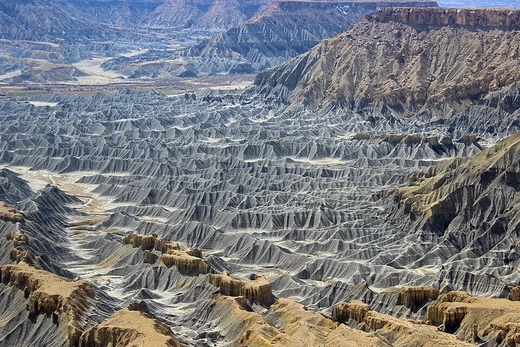
Butte
Isolated hill with steep sides and flat top.

A butte is an isolated hill with steep, often vertical sides and a small, relatively flat top, smaller than mesas, plateaus, and tablelands. The term comes from the French word 'butte,' meaning 'knoll,' and is prevalent in the Western United States, especially the Southwest. Geographers distinguish buttes from mesas by the rule that a butte has a top narrower than its height, while a mesa's top is wider. Buttes form through weathering and erosion when a hard caprock overlies less resistant rock, protecting it from wind abrasion and leaving it standing isolated.
- field
- Geomorphology
- known_for
- Isolated hill with steep sides and small flat top; smaller than a mesa
- distinguishing_rule
- Top narrower than its height
- formation_process
- Weathering and erosion of caprock over less resistant rock
- notable_examples
- Mitten Buttes, Thumb Butte, Devils Tower
Lore & Background
Buttes form when a hard caprock overlies a layer of less resistant rock. The caprock resists erosion, protecting the softer rock below from wind abrasion, leaving the butte standing isolated. As the top erodes, fallen material adds to the scree or talus slope around the base. On a smaller scale, the same process creates hoodoos.
Reader's Guide
Buttes are significant as distinctive landmarks in plains and mountainous areas, frequently appearing in Western-themed films. The Mitten Buttes of Monument Valley, on the Utah–Arizona state line, are among the most recognized, providing backdrops for seven movies directed by John Ford. Thumb Butte in northern Arizona is a prominent geologic landmark overlooking Prescott. Devils Tower in Wyoming is a laccolithic butte composed of igneous rock, unlike typical sedimentary buttes. The term is sometimes applied more broadly to steep-sided hills with pointed or craggy tops, such as Scotts Bluff in Nebraska, Crested Butte in Colorado, and Elephant Butte in New Mexico. Other non-flat-topped buttes include Bear Butte, Black Butte, and the Sutter Buttes. Some hills technically not buttes bear the name, like Kamiak Butte and Steptoe Butte in Washington.
Did You Know?
- The word butte comes from the French word 'butte,' meaning 'knoll.'
- Geographers use the rule of thumb that a butte has a top narrower than its height, while a mesa's top is wider.
- The Mitten Buttes of Monument Valley provided backgrounds for seven movies directed by John Ford.
- Devils Tower in Wyoming is a laccolithic butte composed of igneous rock, not sedimentary rock.
Frequently Asked Questions
What exactly is a butte in geomorphology?
A butte is an isolated hill characterized by steep, often near-vertical sides and a small, relatively flat summit. It sits below mesas, plateaus, and tablelands in overall size.
How do I tell a butte apart from a mesa?
The standard rule is simple: if the flat top is narrower than the feature's height, it's a butte; if the top is wider than the height, it's a mesa.
What process creates a butte?
A hard caprock layer shields the softer rock beneath it from wind abrasion and weathering. As the surrounding landscape erodes away over time, the protected column is left standing as an isolated butte.
Where are buttes most commonly seen?
The term is especially prevalent across the Western United States, with the Southwest region hosting some of the most iconic examples.
Can you name some well-known buttes?
Mitten Buttes, Thumb Butte, and Devils Tower are frequently cited as notable examples of the landform.
More in Coastal And Fluvial Geomorphology 1-24
Elsewhere in the Coastal And Fluvial Geomorphology universe
Spotted an error? Know more?
This is a living reference — every entry is fact-audited, and reader corrections feed straight into our audit queue. Suggest an edit · See this site's audit record