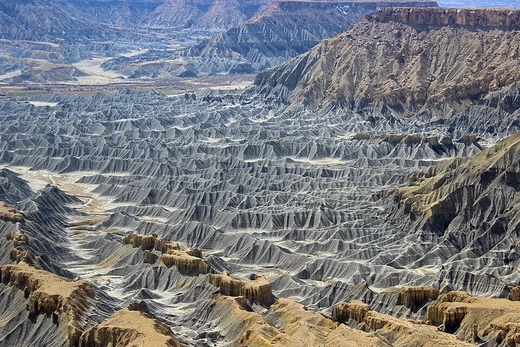
Braided river
A river with multiple shifting channels separated by temporary islands.

A braided river, also called a braided channel or braided stream, consists of a network of river channels separated by small, often temporary, islands called braid bars (or, in British English usage, aits or eyots). Braided streams tend to occur in rivers with high sediment loads or coarse grain sizes, and in rivers with steeper slopes than typical straight or meandering channels. They are also associated with rivers that have rapid and frequent variation in water flow and with rivers that have weak banks.
- also known as
- braided channel, braided stream
- key features
- network of multiple shallow channels, ephemeral braid bars
- typical environments
- gravelly mountain streams, sand bed rivers, alluvial fans, river deltas, depositional plains
- contrast with
- meandering river (single sinuous channel) and anastomosing river (semi-permanent channels separated by floodplain)
- formation factors
- high sediment load, steep slope, variable discharge, weak banks, bedload transport
- notable examples
- Brahmaputra River (India), Platte River (USA), Scott River (Alaska), Donjek River (Yukon), Tagliamento (Italy), Waimakariri River (New Zealand)
Lore & Background
Braided rivers form when a river carries an abundant supply of sediments. Experiments with flumes show that a river becomes braided when a threshold level of sediment load or slope is reached. The proportion of suspended load to bed load also matters: an increase in suspended sediment allows deposition of fine erosion-resistant material on the inside of a curve, which can shift a river from braided to meandering.
Reader's Guide
Braided rivers are significant because they represent a distinct river pattern shaped by high sediment loads, steep slopes, and variable discharge. They are found worldwide in environments such as gravelly mountain streams, sand bed rivers, alluvial fans, river deltas, and depositional plains. Notable examples include the Brahmaputra River in northeastern India, the Platte River in the United States, and the Scott River in Alaska. The physical processes determining whether a river becomes braided or meandering are not fully understood, but numerical simulations have become increasingly important for understanding braided rivers. Braiding is reliably reproduced in simulations when there is little lateral constraint on flow and significant bedload transport. Braided rivers differ from meandering rivers (single sinuous channel) and anastomosing rivers (multiple semi-permanent channels separated by floodplain). Their channels and braid bars are usually highly mobile, often changing significantly during flood events.
Did You Know?
- Braided rivers consist of a network of multiple shallow channels that diverge and rejoin around ephemeral braid bars.
- The braid bars are usually unstable and may be completely covered at times of high water.
- The enormous Brahmaputra River in northeastern India is a classic example of a braided river.
Frequently Asked Questions
What is a braided river?
A braided river is a fluvial channel system composed of many shallow, interwoven streams divided by small, often short-lived sediment islands called braid bars. Rather than following a single course, the river fans out into a shifting web of multiple paths.
What causes a river to develop a braided pattern?
Braiding typically emerges when a river carries a heavy sediment load, flows over a steeper gradient than a typical meander, experiences frequent and rapid swings in discharge, and has banks that erode easily. These combined conditions encourage the channel to split, recombine, and split again.
How does a braided river differ from a meandering or anastomosing river?
A meandering river traces one sinuous path, while a braided river simultaneously occupies several shallow channels. An anastomosing river also has multiple channels, but its separating islands are semi-permanent floodplain features, whereas braid bars in a braided system are ephemeral and constantly reworked.
Where can I find well-known braided rivers?
Frequently cited examples include the Brahmaputra in India, the Platte River in the United States, and the Scott River in Alaska. Braided patterns are also common in gravelly mountain streams, sand-bed rivers, alluvial fans, and depositional river deltas.
What role do braid bars play in the braided-river system?
Braid bars are the small, often temporary sediment islands that physically separate the individual channels within the braid network. They are continually built up and reworked by bedload transport, which is the mechanism that keeps the channel geometry in constant flux.
More in Coastal And Fluvial Geomorphology 1-24
Elsewhere in the Coastal And Fluvial Geomorphology universe
Spotted an error? Know more?
This is a living reference — every entry is fact-audited, and reader corrections feed straight into our audit queue. Suggest an edit · See this site's audit record