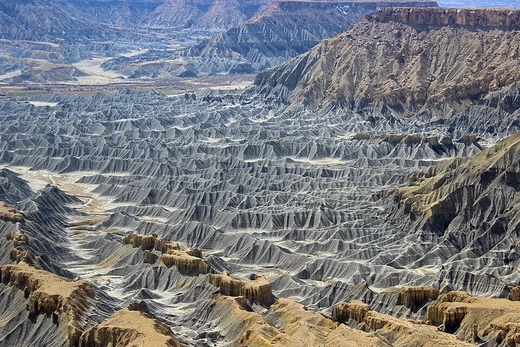
Cross-bedding
Inclined layers in rock reveal ancient flow directions.

Cross-bedding, also known as cross-stratification, is a sedimentary structure in which layering within a stratum is inclined relative to the main bedding plane. These roughly horizontal units consist of inclined layers, formed during deposition on the sloping surfaces of bedforms such as ripples and dunes, indicating the presence of a flowing medium like water or wind. Cross-bedding is significant because it allows geologists to interpret ancient environments, including paleocurrent directions and depositional settings.
- field
- Geology
- known_for
- Sedimentary structure indicating paleocurrent and depositional environment
- type
- Geological structure
- environments
- Rivers, tide-dominated coastal and marine settings, aeolian dunes
Lore & Background
Cross-bedding forms through the downstream migration of bedforms such as ripples or dunes in a flowing fluid. As fluid flows, sand grains saltate up the stoss side of the bedform and accumulate at the peak until the angle of repose is reached, causing avalanches down the lee side. Repeated avalanches create the inclined layers known as cross-strata, which dip in the direction of the paleocurrent. The sediment is typically sorted before and during deposition on the lee side, allowing cross-strata to be recognized in rocks and sediment deposits. Cross-bedding can be subdivided into tabular (planar) cross-bedding and trough cross-bedding based on geometry. Tabular cross-bedding consists of units with planar bounding surfaces and curved foreset laminae that become tangential to the basal surface, formed mainly by migration of large-scale, straight-crested ripples and dunes during lower-flow regimes. Trough cross-bedding has curved or scoop-shaped lower surfaces that truncate underlying beds, with foreset beds also curved and merging tangentially with the lower surface, associated with sand dune migration. Paleocurrent direction is important for reconstructing past climate and drainage patterns, such as prevalent wind directions from sand dunes or river flow directions from current ripples.
Reader's Guide
Cross-bedding is a fundamental tool for interpreting ancient sedimentary environments. By measuring the dip direction of cross-beds, geologists can determine paleocurrent directions—the direction of sediment transport—which helps reconstruct past climate, drainage patterns, and wind regimes. The type and condition of sediments, including grain rounding, sorting, and composition, provide additional clues about the depositional environment; for example, well-rounded, well-sorted quartz sand suggests beach environments, while poorly sorted, angular sediment with diverse minerals indicates river settings near the source. However, caution is needed because older deposits can be eroded and re-mobilized, and distinguishing between dune and antidune cross-beds can be difficult, as dunes dip downstream while antidunes dip upstream. The geometry of cross-bedding—tabular versus trough—also informs about flow conditions and bedform types. Cross-bedding can form in any environment with fluid flow over mobile sediment, including rivers, tidal areas, and aeolian dunes, with individual cross-beds ranging from centimeters to hundreds of feet in thickness depending on the depositional environment and bedform size.
Did You Know?
- Cross-bedding indicates that the depositional environment contained a flowing medium, typically water or wind.
- The foresets of cross-beds are deposited at the angle of repose, approximately 34 degrees from the horizontal.
- Cross-bedding can form in any environment where a fluid flows over a bed with mobile material, including rivers, tidal areas, and aeolian dunes.
More in Coastal And Fluvial Geomorphology 1-24
Elsewhere in the Coastal And Fluvial Geomorphology universe
Spotted an error? Know more?
This is a living reference — every entry is fact-audited, and reader corrections feed straight into our audit queue. Suggest an edit · See this site's audit record