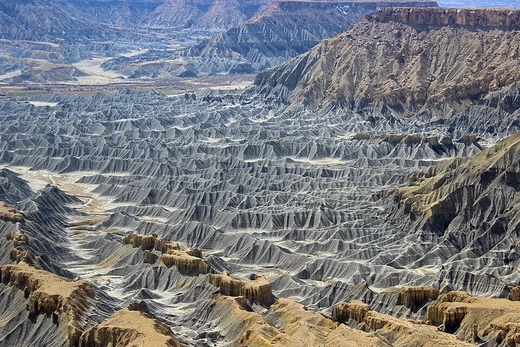
Cut bank
Erosional outer bank of a meandering stream.

A cut bank, also known as a river cliff or river-cut cliff, is the outside bank of a curve (meander) in a water channel (stream), which is continually undergoing erosion. Cut banks occur on the outer side of meander bends, opposite the point bar or slip-off slope on the inner side. They are shaped much like a small cliff, and are formed as the stream collides with the river bank. It is the opposite of a point bar, which is an area of deposition of material eroded upstream in a cut bank.
- field
- Geomorphology
- known_for
- Erosional landform on the outer bend of a meandering stream
- characteristics
- Steep, nearly vertical, unstable, area of fastest and deepest water flow
Lore & Background
Cut banks are steep and may be nearly vertical. Erosion can undercut a cut bank and cause masses of bank material, trees, and vegetation to collapse or slide into the river; flooding and bank erosion can also damage nearby property and structures. Given enough time, the combination of erosion along cut banks and deposition along point bars can lead to the formation of an oxbow lake.
Reader's Guide
Cut banks are significant as a primary site of lateral erosion in meandering streams, shaping river valleys over time. Their steep, unstable nature poses hazards to nearby structures and vegetation, as undercutting can cause collapse. The faster, deeper flow along cut banks drives the erosion that, paired with deposition on point bars, can eventually isolate meander loops into oxbow lakes. Understanding cut banks is essential for managing riverbank stability, predicting channel migration, and interpreting fluvial landscapes. They represent a key component of the dynamic balance between erosion and deposition in river systems.
Did You Know?
- Cut banks are also known as river cliffs or river-cut cliffs.
- They occur on the outer side of meander bends, opposite the point bar.
- Erosion of a cut bank can cause trees and vegetation to collapse into the river.
- The combination of cut bank erosion and point bar deposition can form an oxbow lake.
More in Coastal And Fluvial Geomorphology 1-24
Elsewhere in the Coastal And Fluvial Geomorphology universe
Spotted an error? Know more?
This is a living reference — every entry is fact-audited, and reader corrections feed straight into our audit queue. Suggest an edit · See this site's audit record